Monday, October 20, 2008

Interesting Interactive Maps

Click on the map above to link to a really good interactive map website which allows you to look at all sorts of variables such as population, health, farming and industry and to resize countries according to these variables.

Here, for example, is the world drawn so that the size of the countries reflects the size of their populations...
This one shows carbon emissions.....
Why not go and make some maps of your own?

Sunday, October 19, 2008

South Georgia webcam again.....

Lots of seal pups are arriving on a daily basis in South Georgia..... I still find it amazing that a couple of clicks can transport me from Broughty Ferry to South Georgia.....

The weather in South Georgia (despite the onset of spring) looks pretty grim today as this view which was 'beamed across' cyperspace a few moments ago shows. Check out those icebergs!However, it is only a matter of time before we will start to see the first penguins like these ones which I caught last year..

Stephen Fry in America

I missed last Sunday's first episode of 'Stephen Fry in America' so was delighted to catch it repeated last night. If you haven't started to watch it, it looks as if it will provide an easy-viewing way to visit every state of the USA. It has a sort of Michael Palin feel about it - a travelogue with a well written commentary plus human interest stories. If you missed the first episode, it will be available for some time on the iPlayer . And, of course, these days it seems nothing is safe from 'You Tube'. The first episode has already been divided into chunks and uploaded. So here is the first chunk. Hopefully it will whet your appetite to check out the iPlayer for what you missed and to watch subsequent episodes when they are broadcast.

Monday, October 13, 2008

Farming in East Anglia

.... especially for Form 4 (who have been looking at rural change) and on the off-chance that you might be looking at the blog during your holiday! I have just discovered that the videos which appear on the Britain from Above website may be legally embedded in websites. This is most unlike the BBC who normally strongly disapprove of such activities. So well done BBC !

Here are a selection relevant to what we have been studying in the last couple of weeks about farming in East Anglia.....


They offer a nice sequence describing change in farming in the last 50 years.

Thursday, October 09, 2008

World Map Quiz

Specially for my F2 class who loved this when we played it in class today.....

Click on the map to link. I am expecting amazing world knowledge when you come back after your holiday!

Monday, September 29, 2008

Time to start watching the S Georgia webcam again!

I have been invited to attend an event at Discovery Point tomorrow evening. HRH Princess Anne will be there and we are to see a performance of 'Tom Crean', a play about one of the crew who was on Ernest Shackleton's ship the 'Endeavour'. The connection between Tom Crean and the island group of South Georgia in the Southern Atlantic will feature in the play but if you follow the link above, you will be able to read for yourself what the connection is.

I have posted about South Georgia a few times on this blog and always in connection with the webcams which are located there. The webcam views are always particularly interesting during the summer months in S Georgia which are about to begin now as S Georgia is in the southern hemisphere. From now until March you can watch live pictures of seals and penguins on the beach in South Georgia... views just like the ones below (no penguins today but great seals!)

Over the next few months the snow and ice will gradually disappear from all but the highest peaks and you will see some amazing wildlife on that beach thousands of miles away.

Monday, September 15, 2008

Scottish Food Fortnight

The fact that we are now in the middle of Scottish Food Fortnight had completely escaped my attention until today. However, when I came across it on the BBC website, I thought that some of the info and links were particularly relevant to Form 2 pupils who are currently studying food miles.
One of the offshoots of the SFF is an 'experiment' by two BBC reporters. Over the space of a week they are trying to survive on only food produced from their respective regions......
There is a clear link with the work we have been doing on food miles. If we could source more of our food locally, we would have less need to eat 'exotic' fruit and veg and would therefore cut down on our food miles. You can read the daily reports of the BBC reporters here.
There is also a good set of resources on food miles on the BBC website which you can access here.
You might well find this helpful when you have to produce your assessment later in the term!

Thursday, September 04, 2008

Food Miles Map generator

Specifically for Form 2 classes..... here's one I made earlier.
Click on the thumbnail map below and it will open up to show you my map.


Get your own Visited Countries Map
Your homework (if you are in Mrs V's class anyway), is to produce a food miles map for your family for the next week. I gave you one url in class today for generating a map but if you click on the link above, it will take you to another website which will do the same thing.

Wednesday, September 03, 2008

He's back!

Last year he was presenting 'Earth:the Power of the Planet' . This year it is to be 'Earth : the Climate Wars' . In the first of three documentaries beginning this Sunday (6th September) on BBC2 at 9pm, Dr Iain Stewart will be tracing the history of climate change research and examining the potential for ecological catastrophe as climate change becomes a reality.


There is a good resume of this week's programme here (follow the link at the top of the page). It begins .... "Global warming, and how to combat it, is arguably the greatest challenge faced today. It has provoked intense debate, changed the way people see the planet and created headlines around the world. People now know how important the issues are. But when and how did scientists first discover global warming? Why has it led to such a furious debate? And who should be believed? "


Although the BBC website doesn't seem to have supporting webpages for the programme, they do have a good resource on climate change which you can link to by clicking the image below.....

Sunday, August 31, 2008

That was the month that was

With only two hours of August left and no sign of a dramatic change in the weather before midnight, here are the preliminary results of my weather calculations for the month...

176mm of rain fell in Dundee this month. Given that the total annual rainfall is around 750mm, this means that slightly under one quarter of the annual rainfall fell in just one month! The long term average for Dundee in August is 55mm and so August this year in Dundee was three times wetter than usual. I can certainly believe that. However, 170 of the 176 mm had fallen by the 27th of the month. What happened on the 28th? We went back to school!

Something else happened on the 28th. The sun shone and the temperature rose! The same happened on the 29th. In fact, the two warmest days of the month were Thursday at 21.5 degrees and Friday at 20.9 degrees. And what happened on those days? Yes, we were back at school!! Mindyou, we weren't the hottest ... by a long way. According to the BBC weather report on Thursday it was really sweltering in Windsor..
However, before we start feeling sorry for ourselves, let us spare a thought for the people of the Caribbean and the Gulf Coast of the USA, who are now in the hurricane season and have either already felt the fury of Hurricane Gustav or are waiting for the storm to strike. In particular, we should remember the people of New Orleans, many newly returned to the city after the ravages of Katrina three years ago, who are now being evacuated again.

There is a good animated guide here which explains how hurricanes form and below, an image courtesy of the Met Office at 7pm this evening showing Gustav approaching the Gulf coast...

Meanwhile, the population of New Orleans prepare for Gustav's arrival


Friday, August 29, 2008

Britain's happiest places and fattest places!

Forget maps of lowlands and hills! What about maps of happiness and obesity?

There has been a lot of information in the press over the last two days about the locations of Britain's happiest and fattest people. It seems the happiest people live in a rural area of mid Wales and the fattest people are in the Shetlands.

The questionnaire which was used to compile the happiness data along with the results for 273 districts in the UK can be found here. If you check it out you will see that Dundee comes a lowly 263 out of 273! Cheer up - it could be worse. Glasgow is 268th. The BBC website also carries a report of the study here.

The distribution of obesity across Britain is similarly interesting. While it is harder to see patterns in Scotland, in England there is definitely a fatter north and west and a leaner south and east.


Sunday, August 24, 2008

Industrial icons demolished

The disused 'Tinsley Towers' , 65m high cooling towers (associated with a former coal fired power station) which were located beside the M1 between Sheffield and Rotherham were demolished early today by power company E.on, despite protests that the landmarks should be preserved. 12,000 people turned up in the middle of the night to watch their destruction.


The land released by their demolition is to become the site of a new power station but this one will burn recycled wood and produce enough electricity for 40,000 homes.

Friday, August 22, 2008

A geographical medals table?

There has been a bit of discussion in the press over the last few days about how the Olympic medals table should be shown. Clearly countries such as China with very large populations are more likely to win medals. Similarly, countries which can afford to invest money in sport facilities and training are more likely to produce medal winners. Such countries are likely to have a large GDP (Gross Domestic Product). Here are a couple of 'alternative' medal tables....

Thursday, August 21, 2008

Wet, wet, wet...

A couple of months ago, I was thinking about going to Mumbai this summer. Then someone who knows India well, suggested that July and August would not be the best time to go ...on account of the monsoon. So I went to Cornwall and Devon instead and it rained there and then I came back to Dundee and it has deluged for six weeks!

The weather stats for the summer are fascinating and back up what so many people are saying about this summer's weather : that it is not just disappointing but it is also odd. The 'Courier' published this data about July... it was the windiest July since 1974 and it was also twice as wet as usual. Despite that, daily average temperature was actually up! (probably because it remained very cloudy at night).

So what about August? After another day of torrential downpours that remind me of the kind of rain I've experienced in equatorial areas, I've done a bit of research. There is a weather station located near Asda on the Kingsway which I can log into to get weather data and here is what it shows for rainfall for the month so far.....

Each 'step' represents a sudden increase in rain. The graph is cumulative and shows rainfall since the weather station was set up in May. On the Ist August, the total rainfall was 117mm. Today it is 283mm 1.e. 165mm in just 21 days. Our total ANNUAL rainfall in Dundee is 750mm. It is therefore quite possible that by the end of the month, we will have received one quarter of our annual rainfall in just one month.

So, why is this happening? One explanation is global warming. Remember that climate change is not just about long, hot summers and vineyards in Tayside. It could be about milder, less snowy winters and windier, wetter summers. When temperatures increase, air rises giving low pressure and increasing winds. Rising air also condenses, forms clouds and....produces rain!

The forecast is for a drier September ... when it get cooler. Well, you can't have everything!

Monday, August 18, 2008

Welcome back to GMPAY

The holidays are almost over and a new session is about to begin. A special welcome, therefore, to new readers of 'Geography : My Place and Yours'.

I'm hoping that some of you may have been watching the new BBC series on Sunday evenings called 'Britain from the Air'. It has been full of great Geography! The last of three episodes will be shown this Sunday but you still have time to catch up on last night's episode on BBC iPlayer.
If you haven't watched it, here's a flavour of what you've missed...

Sunday, June 22, 2008

Nature's Fury

The past week has seen an astonishing range of natural events in Asia which have sadly claimed lives ...Last Saturday an earthquake of magnitude 7.2 struck Hokkaido (the north island ) in Japan. There is some video footage here. You can also read an account of the earthquake here and access a series of images by clicking on the image above.

Over the last 36 hours, the Philippines kave been ravaged by a powerful typhoon..... Click on the image above to access the BBC website information about this typhoon. BBC also has a very good animated guide to typhoons. Sadly this morning it is also reporting a large loss of life in the Philippines as a result of a ferry capsizing in the wake of the typhoon. There is asome video footage here.

So recently affected by a huge earthquake, south China is now battling some of the worst floods it has seen in 50 years.... You can read reports of the flooding here and here. Nearly six million people have been affected by the flooding in one way or another. China’s rainy season causes havoc every year.
But this year China has already had the snowstorms that paralyzed much of the country and last month’s devastating earthquake to cope with. This latest flooding is another major challenge for the Chinese people and their government, just weeks before the Olympic Games get under way in Beijing.

Sunday, June 08, 2008

A Chinese perspective on the Sichuan 'quake

Here is a different and very poignant 'take' on the recent earthquake in China. It shows how the Chinese media (including its web pages and search engines) reported on the national 3 day mourning for victims of the Sichuan 'quake......
Click the image above to link to an excellent and thought provoking presentation.

Tuesday, May 06, 2008

Cyclone in Myanmar

Details of the loss of life and the extent of the damage caused when Cyclone Nargis swept through the south of Myanmar (Burma) on Saturday are now beginning to appear in the press and media. In a chilling reminder of the rising figures in the aftermath of the Asian tsunami in 2004, the death toll has risen steadily from just a few hundred to a current estimate of 22,000+.


Here is the satellite view on Saturday as the cyclone (called a hurricane in the Atlantic and a typhoon in the Pacific) swept in from the west towards Myanmar......If you click here, you will link to an animated explanation of how and why cyclones occur.
Three days after the cyclone struck, you can read the latest news, watch some video footage and hear eyewitness reports from the region on the BBC website.

Saturday, March 29, 2008

Who put the lights out?

Why does the Google search engine have a black background today? Click on it to find out or watch the video below..

Saturday, March 22, 2008

Look at the World!

if you click on the banner above, you will link to a new website produced by teachers from British Columbia in Canada. Its aims is to present in "as clear, objective, and accessible a format as possible - the condition of the world -- both its natural and human elements. "

From the home page, if you drop down the 'data' menu, you will get a list of 11 topics, eack of which is presented in chart and fiagram form. There are a wealth of resources which could be useful..... and not just for geography!

Wednesday, February 20, 2008

Anywhere is possible...

Thought you might like to see this... especially is you've been to see 'Jumper'!

Monday, February 04, 2008

Geography matters!

Here's why...

Sunday, January 20, 2008

Not a word of a lyre!

One of my 'virtual colleagues' has recently pointed out this excellent video clip - it is an unusual but very powerful example of human impact on the environment. Click on the image to link....
I think it is quite amazing.

Thursday, January 10, 2008

Mark the spot!

I haven't posted on GMPAY for a couple of weeks as I have been very busy writing daily up-dates on the progress of our FP Mark Beaumont who is currently cycling around the world. Mark is now in New Mexico (USA) having cycled 14,500 miles of his 18000 mile route. It now looks likely that he might complete his epic journey in under 200days.
Click on the map to link to all the latest on 'Geo Blogging with Mark'

Friday, December 21, 2007

"Let it precipitate ice crystals...."

Especially for F1 who have been studying the weather recently.....Click on the image above to make your own snowflakes.

And for all the rest of you who have been "good boys and girls"....Click on the image to link to the NORAD tracking Santa website. This year it is even better than usual - Santa is using Google Earth!

And a 'postcard' from Mrs V to all of you....


Have a lovely holiday - I'll definitely be having a white Christmas! Click on the image and you will link to the webcams in Meribel - I'll be the one waving!

Wednesday, December 12, 2007

White House Barney promotes the National Parks

The White House Christmas video starring Barney, the Scottie dog whose master is President Bush, has become compulsory viewing in recent years. This year it has a geographical theme as the video is used as a loosely disguised advert for National Parks! Click on the image below to link to the video

Wednesday, December 05, 2007

GLOFs

I know from discussions in school today that a lot of you watched 'Earth : Power of the Planet' last night and that you were all as amazed as I was by the sequence describing the glacial lake outburst flood (GLOF )which occurred thousands of years ago in N America . It was a bit of a coincidence,therefore, to find video footage on the BBC website today about a threated GLOF in Nepal....High in the Himalayas lakes like this one are lengthening by as much as 100m a year. Global warming has produced an average temperature rise of 1.5 degrees C in just 40 years in Nepal and glaciers are melting fast. Many of the lakes which are produced are held back by unconsolidated mounds of debris known as moraines. If these natural dams fail (and history shows that they often do) then millions of gallons of water would sweep down the valleys, anihilating everything in their path.

In a cruel twist of fate, once the waters have gone, the area is likely to suffer drought as the glaciers which fed the meltwater streams will have retreated so much that they no longer release the water on which local communities currently depend. You can watch a video about GLOFs in Nepal by clicking on the photo above.
P.S. GMPAY is 200 postings old today!

Monday, December 03, 2007

Plant some bagpipes this Christmas!

I opened my copy of 'Scotland on Sunday' yesterday and read an article which made me think it might be the beginning of April instead of the beginning of December!

Apparently one of the ethical gifts you can give this year are 15 bagpipe saplings.... (there is a geographical connection, honestly!)

If this idea intrigues you and you'd like to read more, click on the image on the left. If you 'd really like to spend £15 on ensuring the survival of bagpipes, click here to link to the relevant page of the Good Gifts catalogue.

Personally, I think bagpipes should always be played outdoors and a long way away!!

Saturday, December 01, 2007

6 million others

Since we have recently been 'doing' population with F2, I remembered this interesting website (click to link)
.......where you can explore the lives of some of the other 6 billion. The website is in French but there is an option to get the English version by clicking on the 'English' label.

Thursday, November 29, 2007

Breaking News

The ticker tape at the top of the BBC News website is reporting a very high magnitude earthquake (7.3) off the coast of Martinique in the West Indies. Martinique is no stranger to natural disasters as it sits aside a major plate boundary. Back in 1902 almost 30,000 inhabitants were killed by a violent eruption of Mont Pelée. This was the greatest loss of life from a volcanic eruption in the 20th century.

I will follow the story of this earthquake as it is reported and add some more to this posting later.

Sunday, November 25, 2007

Mt Etna puts on a show

I listened last week to Iain Stewart (Earth : Power of the Planet) saying that Mount Etna on the island of Sicily was his 'favourite' volcano and just a few days later, as if to prove why, it erupted! There is some good footage Friday evening's eruption on the BBC website which you can link to by clicking on the image below. There is no commentary - just lots of good eruption sounds....

Tuesday, November 20, 2007

Earth : The Power of the Planet

Starting tonight on BBC2 at 9pm is a new series which sounds as if it will be spectacular. In 'Earth : the Power of the Planet' , geologist Dr Iain Stewart will be looking at the forces that have shaped the planet starting tonight with volcanoes then moving on to the oceans, atmosphere and ice in the next three weeks before concluding in the final programme that 'Earth has nothing to fear from man'.
Here's what the BBC website for the programme says about tonight's programme . Volcanoes have a fearsome reputation. In reality, they are the most important force in the creation of the planet as we know it today. Iain abseils into a lava lake to show how the heat that fuels volcanoes also drives some of the most fundamental processes on the planet.

You can catch some video footage of the abseil here and also read some extra information about the series here .

Sunday, November 18, 2007

The snow has arrived!

It's strange that on a weekend when the UN have been issuing dire warnings of global warming that the Alps have had an early, bumper fall of snow (the image was taken in Meribel yesterday)
Here in the UK snow has been falling this evening in parts of England.

Cyclone Sidr claims more lives

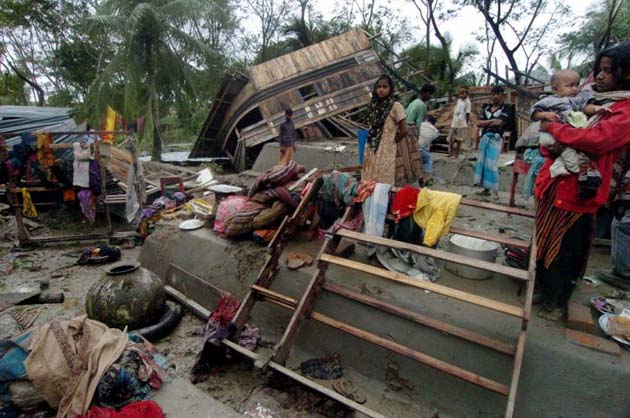
Sadly yesterday's figures for the loss of life which Bangladesh has suffered as a result of Cyclone Sidr now seem to have been greatly underestimated. This report on the BBC website up-dates the story and the figures. Pictures like the one above will be all too common as many children have been left orphaned after losing both parents.

Meanwhile, half a world away, people in northern Chile are recovering from a Richter scale 7.7 earthquake which thankfully caused damage to buildings but little loss of life in the northern city of Tocopilla which is close to the epicentre of the quake . Although the magnitude of the 'quake was high, its focus was deep within the crust and therefore damage at the epicentre was less than might have been expected. Two tectonic plates - the Nazca and the South American - clash in this region.

Saturday, November 17, 2007

Cyclone Sidr

While volcanoes have been 'rumbling' in Indonesia this week, in another part of Asia a violent cyclone (tropical storm) has taken a huge toll of human life. The storm, called Cyclone Sidr, swept in from the Bay of Bengal late on Thurday and affected much of southern Bangladesh. Present estimates suggest that it may have claimed as many as 900 victims but that figure is likely to rise as rescue workers reach remote areas and the fate of the fisherman who were at sea at the time the cyclone hit is revealed. http://geology.com/world/bangladesh-map.gifAs well as 150mph winds and torrential rain, the cyclone unleased a 5m high tidal storm surge which swept inland destroying buildings, livestock and crops as well as claiming a huge human toll in the flat delta lands which make up most of the southern part of the country. There are some very good accounts of the cyclone which you can read on the Internet. For example, this BBC newspage gives a good up-date and there is a very good first hand account of the cyclone from a BBC World Service reporter who has recently been travelling through the country documenting the effect of climate change on its people.

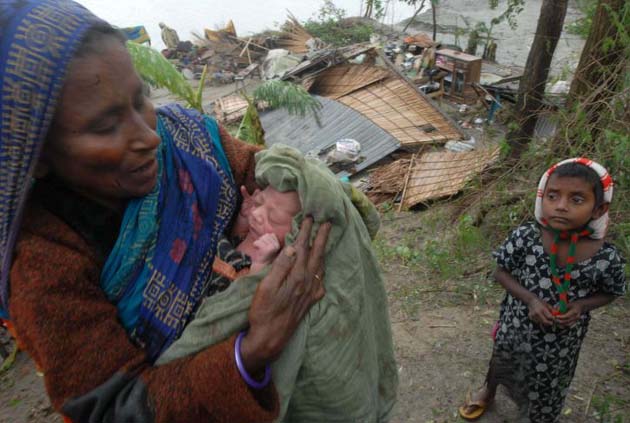
There is a particularly good interactive resource on the Guardian website which has some video footage and some very poignant photos such as this baby born during the storm with the devastated remains of its family home in the background